Just Applied? Start Here.
You just applied to a police, fire, EMS, or dispatch position.
Most candidates immediately focus on the written and physical tests.
Both matter.
But after interviewing, scoring, and hiring hundreds of candidates, I can tell you this:
The interview is where good candidates quietly lose points without realizing it.
I put all my interview experience and knowledge in a 50+ page Interview Guide which will improve your chances of getting hired.
Why The Interview Matters
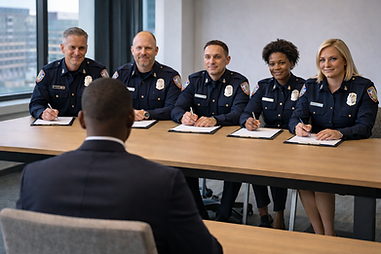
The interview is not a conversation.
It’s a scored evaluation.
The panel is listening for:
-
judgment
-
decision-making
-
communication
-
composure under pressure
Most candidates leave the room with:
-
no feedback
-
no score
-
no idea what helped or hurt them
They assume they did “okay” and wait.
The Guide will teach you:
-
How panels think
-
How interviews are scored
-
How to think under pressure
-
How to answer scenarios
.....and much much more!
What I've Seen On Hiring Panels
I spent over 25 years in law enforcement.
I’ve sat on hiring panels, written interview questions, and used score sheets to evaluate candidates.
Here’s the pattern I see over and over:
-
Smart candidates ramble
-
Motivated candidates give generic answers
-
Well-intentioned candidates lose points on delivery, not content
-
Nervous candidates mistake preparation for memorization
None of that has anything to do with intelligence or experience.
It has everything to do with not understanding how interviews are actually scored.
The Top 5 Interview Questions Every First Responder Should Be Ready For
These are the questions that show up again and again. The difference is not the question. The difference is how your answer is structured and how it lands with the people scoring you.
Start here
Pick one question. Practice a one minute (maximum) answer. Record yourself. Check the suggested answer structure below. Adjust. Practice. Repeat.
If you want deeper preparation, this page pairs well with the First Responder Interview Guide (PDF) and the Watch Commander Academy listed below.
The Questions
1. Tell us about yourself.
2. Why do you want to work for this agency?
3. Describe a time you faced adversity and how you handled it.
4. What techniques do you use to stay calm and focused in high-pressure situations?
5. What motivates you to serve in this position?
The Answers
1. “Tell us about yourself.”
When I asked this question in interviews, I wasn’t trying to learn everything about a candidate. I was watching how they prepared and organized their thoughts, how they communicated under pressure, and how professionally they presented themselves. A strong answer should be one minute or less and have a clear structure.
There is no right or wrong here but I usually recommend starting with where you are now, briefly explaining how you got there, and then ending with why that path points you toward this role. That structure keeps your answer focused and easy to follow BUT NOT memorized!
One of the biggest mistakes I saw was candidates make was listing every job, class, or certification they had. I saw that already on your resume'! Instead, I was looking for a few selected experiences that showed responsibility, teamwork, service, or sound decision-making. A short personal detail is fine if it adds context and maturity.
The strongest candidates sounded prepared and were clear, grounded, and intentional with their words. If I remembered anything after the interview ended, it wasn’t their job history. It was whether they came across as someone who was purposeful, professional, and ready for responsibility. Be memorable from the start for the right reasons!
2. “Why do you want to work for this agency?”
This question tells me very quickly whether you prepared or just showed up. When I asked this, I was listening for proof that a candidate understood who we were, what we did, and why this agency made sense for them specifically. I can't tell you how many candidates didn't know the Chief's name!
Generic answers stand out immediately, and not in a good way. Strong answers referenced real research. That might be the agency’s mission, its role in the community, its training culture, or the type of work it focuses on. What mattered most was how the candidate connected that information to their own values and goals.
Sometimes candidates provided more information about the agency or town than I knew!
Candidates who could clearly explain why this agency fit them signaled maturity and long-term thinking. Those were the people I trusted to invest time and training into.
3. “Describe a time you faced adversity and how you handled it.”
I never asked this question looking for drama. Rather, I asked it to evaluate judgment, accountability, and learning. The strongest answers came from real situations. Not necessarily the most intense ones, but the ones where the candidate could clearly explain what happened, what they did, and what they learned.
Structure mattered here. Candidates who told the story with a clear beginning, middle, and outcome always scored better. Rambling or jumping around usually hurt them.
I paid close attention to whether candidates took ownership or shifted blame. Strong candidates owned their role, even when the outcome wasn’t perfect, and explained how the experience made them better.
What mattered most wasn’t the adversity itself. It was whether the candidate showed growth, reflection, and sound judgment under pressure.
4. “What techniques do you use to stay calm and focused in high-pressure situations?”
This question mattered more than many candidates realized.
When I asked it, I was assessing emotional control, self-awareness, and readiness for stress. Saying “I stay calm” told me nothing. Explaining how you stay calm told me everything.
The strongest candidates described specific techniques. Controlled breathing. Slowing down decision-making. Prioritizing tasks. Relying on training. Clear communication.
I wasn’t looking for perfection. I was looking for tools.
Candidates who could explain their process showed me they understood pressure and had thought about how to manage it responsibly. That mattered far more than confidence alone. A point gainer addition may be to add tools you use to de-stress after a high-pressure situation like running, riding a bike, playing basketball, or whatever calms you down.
5. “What motivates you to serve in this position?”
This is not a passion question. It’s an authenticity question.
When I heard clichés like “I just want to help people,” I knew the candidate hadn’t gone deep enough. Almost everyone who doesn't prepare says that.
The strongest answers usually included a short story. A first responder who mentored them. An interaction that made an impact. A moment that showed them what service and responsibility really meant. The story didn’t need to be dramatic. It needed to be real.
What mattered was how the candidate connected that experience to their desire to serve professionally and responsibly. I was listening for sincerity, maturity, and a genuine service mindset.
What to do next?
If my tips made you rethink how interviews work, here are three ways to go deeper.

Option 1: First Responder Interview Guide (PDF)
A 50+ page, SELF-PACED, panel-side guide to the most common questions, the scoring logic behind them, and how to build answers that sound prepared without sounding scripted.
Option 2: The Watch Commander Academy (Subscription). Private member-only dashboard with FREE First Responder Interview Guide, ongoing training, video vault, weekly online group training, scenario tips, nationwide community support, and more.
Option 3: Mock Interview Experience
A true-to-life 1-on-1 interview experience with a retired Police Lieutenant, including real questions, live scoring, and honest feedback so you know exactly where you stand and most importantly what you need to work on.
Want more tips?
Enter your email below and I will send you how I would actually score the Top 5 Questions and provide tips how to make your answers even STRONGER.